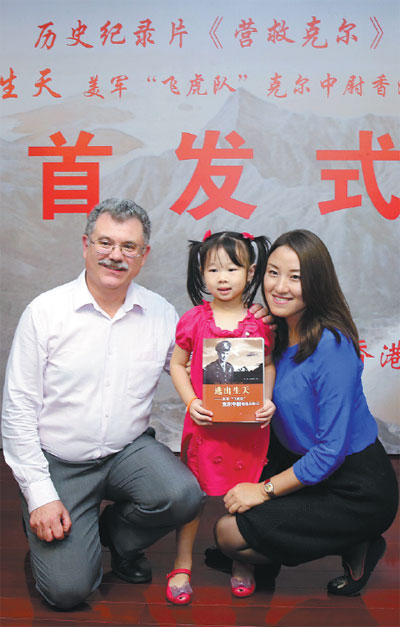
David C. Kerr (left), son of Flying Tigers pilot Donald W. Kerr, poses with descendants of Chinese World War II veterans during a documentary and book launch in Beijing on Friday. [Jiang Dong / China Daily]
During the Chinese People's War of Resistance against Japanese Aggression (1931-1945), a myriad of foreign experts and friends gave unstinting support in that critical period.
Far less well-equipped compared to the advanced Japanese weaponry, China won wide acclaim and sympathy from the international community for its steadfast fight for justice.
Foreign aid from China's friends
Foreign aid came in three forms.
The first was from international societies: the Communist International led by Georgi Dimitrov had called for the proletariat around the globe to support China ever since Japan occupied China's northeast provinces in 1931.
In 1938, a year after full-scale war began, a delegation led by James Klugmann comprising members of World Student Association for Peace, Freedom and Culture arrived in China seeking to grasp the actual situation. After the visit, team members reported on China's resistance to a number of foreign universities, including those of the United States, Britain, Canada, France, Belgium and Netherland.
Other humanitarian support came from a variety of organizations, trade unions and Red Cross societies in Britain and France. In those campaigns, a number of illustrious figures, including John Dewey, Albert Einstein, Roman Rolland, Bertrand Russell, Mahatma Gandhi jointly signed a statement criticizing Japan's invasion and called for the international community to halt economic cooperation with it.
The second kind of support came from foreign governments, mainly military aid. Prestigious generals, such as Joseph Stilwell from the United States and Georgi Zhukov from the former Soviet Union, were among about 1,129 foreign political and military figures who chose to stay in Chongqing (wartime headquarters of the Kuomintang) over a long period.
The third type of aid involved lots of foreign journalists, doctors and military officials, including Edgar Snow, Anna Louise Strong and Agnes Smedley, who stayed the hardships of the Chinese people. Through their writings, the atrocities of the Japanese militarists were exposed to the entire world. Meanwhile, the medical team consisting of doctors from Poland, India, Czech, Austria and Hungary tended to the needs of frontline soldiers.
There were some, such as the French doctor Jean Augustin Bussiere, who even endangered their lives seeking to evade Japanese blockades to get medicines for combatants.
In terms of wartime economic and cultural construction, a number of foreigners, such as Joris Ivens, a Dutch documentary filmmaker, Rewi Alley, a New Zealand born educator and author, and Norman France, a British born educator capable of speaking Mandarin and Cantonese also gave help during the war.
There were also a number of Japanese friends, including Sanzo Nosaka, Wataru Kaji and Koko Ikeda, who joined in the Chinese camp to fight against the aggression of their fascist countrymen.
To cope with refugees fleeing from their homes in Shanghai, the Red Cross built refugee camps. And there were also the Flying Tigers composed by many volunteer U.S. aviators who fought the Japanese invaders. Some foreigners, like Henry Norman Bethune, Dwarkanath Shantaram Kotnis and Grigori Kulishenko even sacrificed their lives.
The influence and role of the foreign friends to the Chinese People's War of Resistance against Japanese Aggression:
First, the medical, technical and personnel help offered by the International community greatly alleviated shortages for Chinese armies. Meanwhile, the issuance of rebukes and boycotts of Japan greatly reduced its capabilities to fight a protracted war.
Second, with the disclosure of Japanese war crimes, the international community was alerted and reversed its view of the war in the Far East. As early as Aug. 29, 1937, a U.S. anti-fascist alliance wrote to Cordell Hull, then Secretary of State, demanding the country to drop its wait-and-see attitude toward Japan's invasion of China. On Nov. 5, 1937, the head of the American Federation of Labor stressed that, if the U.S. did not constrain Japan, which was slaughtering Chinese people with advanced armaments, it would be putting its own security at risk.
Third, wartime friendship with other countries, and the economic or humanitarian support and direct or indirect assistance they offered, greatly inspired the Chinese people to persevere in resisting Japanese aggression.
The war on the mainland tactically obstructed the Japanese intruders and alleviated the burden on European countries.
Fourth, there was the contribution of revealing the truth about the Communist Party of China (CPC). Following American journalist Edgar Snow, a large number of journalists, scholars and missionaries from the West, as well as Evans Fordyce Carlson, a U.S. Marines intelligence officer, visited Yan'an and other anti-Japanese base areas in the enemy's rear to talk with CPC leaders, learn about the Red Army and cover their efforts in the war. As a result, a large quantity of first-hand material on China's Communist movement was made known to the public and drew high praise from all over the world for the CPC and the growing influence of the battles fought by the Eighth Route Army, the New Fourth Army and various CPC-led guerrillas in the enemy's rear. Their words presented a positive image of the CPC, increased its influence, and even affected some countries' decision-makers. For instance, Carlson sent letters to President Franklin D. Roosevelt almost every week on his experiences in China. The letters were inspiring and showed the latter the value of guerrilla warfare. Roosevelt also read Edgar Snow's Red Star over China and met Snow three times to learn about China's counter-Japanese war and the CPC.
Fifth, the efforts of these foreign friends had profound influence on China's relations with other countries after the war.
They came from numerous social circles of many countries. There were government officials, social celebrities, educators, writers, journalists, medical staff, industrialists, religious personages and servicemen. They might differ in family background, occupation, faith and view on China, but they shared one thing in common: helping the Chinese people in their struggle to repel the brutal Japanese invaders.
Some of these people traveled a long way to help the Chinese despite the dangers and hardships. Their decision to travel to China, their aid to the Chinese people and their hard efforts in the war represented their friendship with the Chinese people and their goodwill to the country.
As an inseparable part of the Chinese people's war against Japanese invasion, they will never be forgotten. Chinese President Xi Jinping's remark on the 69th anniversary of the Chinese People's War of Resistance against Japanese Aggression reflected Chinese people's feelings. He said: "Our anti-fascist allies like the former Soviet Union, the United States and the United Kingdom provided much manpower and material support for Chinese People's War of Resistance against Japanese Aggression, and anti-fascist warriors from the Democratic People's Republic of Korea, Vietnam, Canada, India, New Zealand, Poland, Denmark, Germany, Austria, Romania, Bulgaria and Japan joined hands with us in the war. We won't forget those friends who supported us and even sacrificed their lives.
"We won't forget those friends who helped the Chinese people in Nanjing Massacre. We won't forget the veterans from the 'Flying Tigers' and the Soviet Red Army. We won't forget those doctors including Dr. Henry Norman Bethune and Dr. Dwarkanath Shantaram Kotnis, and those journalists who reported the war honestly.
"Chinese people will forever remember those friends who made their contribution to Chinese People's War of Resistance against Japanese Aggression."
The author is the researcher of the Party School of the Central Committee of the Communist Party of China.
The article is translated by Wu Jin, Chen Xia, Lin Liyao and Guo Yiming and the unabridged versionwas first published in Chinese.
Opinion Articles reflect the views of their authors, not necessarily those of China.org.cn
责编:蒋俊
来源:China.org.cn